
Heteroatom-Containing Macrocycles
Most macrocycles, including pillar[n]arenes, are composed mainly of carbon, hydrogen, and oxygen. To expand their functionality, we are developing macrocycles in which heteroatoms are incorporated into the cyclic frameworks. The introduction of heteroatoms can alter the structures and optical properties of macrocycles, while also enabling molecular recognition and controlled molecular assembly based on the intrinsic characteristics of each element. We are also extending this concept to polymer materials by taking advantage of the unique properties of heteroatoms.
Results by Element
Nitrogen (N)
![Solid-State Emissive Pillar[6]arene Derivatives Having Alternate Methylene and Nitrogen Bridges](images/publication/2024/2024-7.jpg)
Pillar[6]arene derivatives bearing nitrogen atoms at the bridging positions were synthesized, and their solid-state emission properties were clarified. This result demonstrates that the introduction of heteroatoms enables control over the photophysical properties of macrocycles.Chem. Asian J. 2024
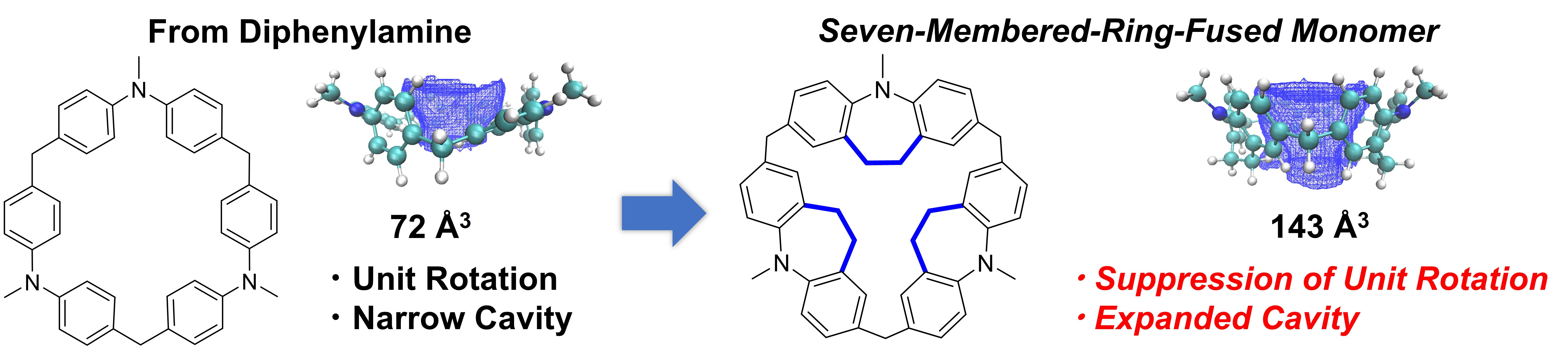
Macrocyclic arenes with expanded cavities were synthesized from seven-membered-ring-fused monomers. This work shows that ring-structure design can provide macrocycles with distinct cavity sizes and host–guest properties.Chem. Eur. J. 2025
Silicon (Si)
![Silapillar[ n ]arenes: Their Enhanced Electronic Conjugation and Conformational Versatility](images/publication/2024/2024-5.jpg)
Silapillar[n]arenes bearing silicon atoms at the bridging positions were synthesized, leading to extended electronic conjugation and the induction of diverse conformations. This result demonstrates that silicon bridges can provide electronic states and three-dimensional structures that are not accessible with conventional carbon bridges.J. Am. Chem. Soc. 2024
Sulfur (S)
![Sulfur[ n ]arenes: Synthesis and Solid-State Supramolecular Dimerization via Multiple Sulfur···Sulfur Interactions](images/publication/2025/2025-7.jpg)
A new class of sulfur-containing macrocycles, sulfur[n]arenes, was synthesized, and their solid-state dimerization through sulfur–sulfur interactions was revealed. This result shows that the characteristics of sulfur atoms can be used to control the assembly structures of macrocycles.J. Am. Chem. Soc. 2025
![N-Sulfur[n]arene: Synthesis and Solution-State Double-Threaded Dimerization Assisted by Multiple S···S Interactions](images/publication/2026/2026-3.jpg)
Nitrogen-embedded sulfur[n]arene derivatives were synthesized and shown to form double-threaded dimers in both the solid state and solution through alkyl-chain inclusion and multiple S···S interactions. This result demonstrates that combining heteroatoms with molecular inclusion enables control over assembled structures even in solution.Org. Lett. 2026
Fluorine (F)
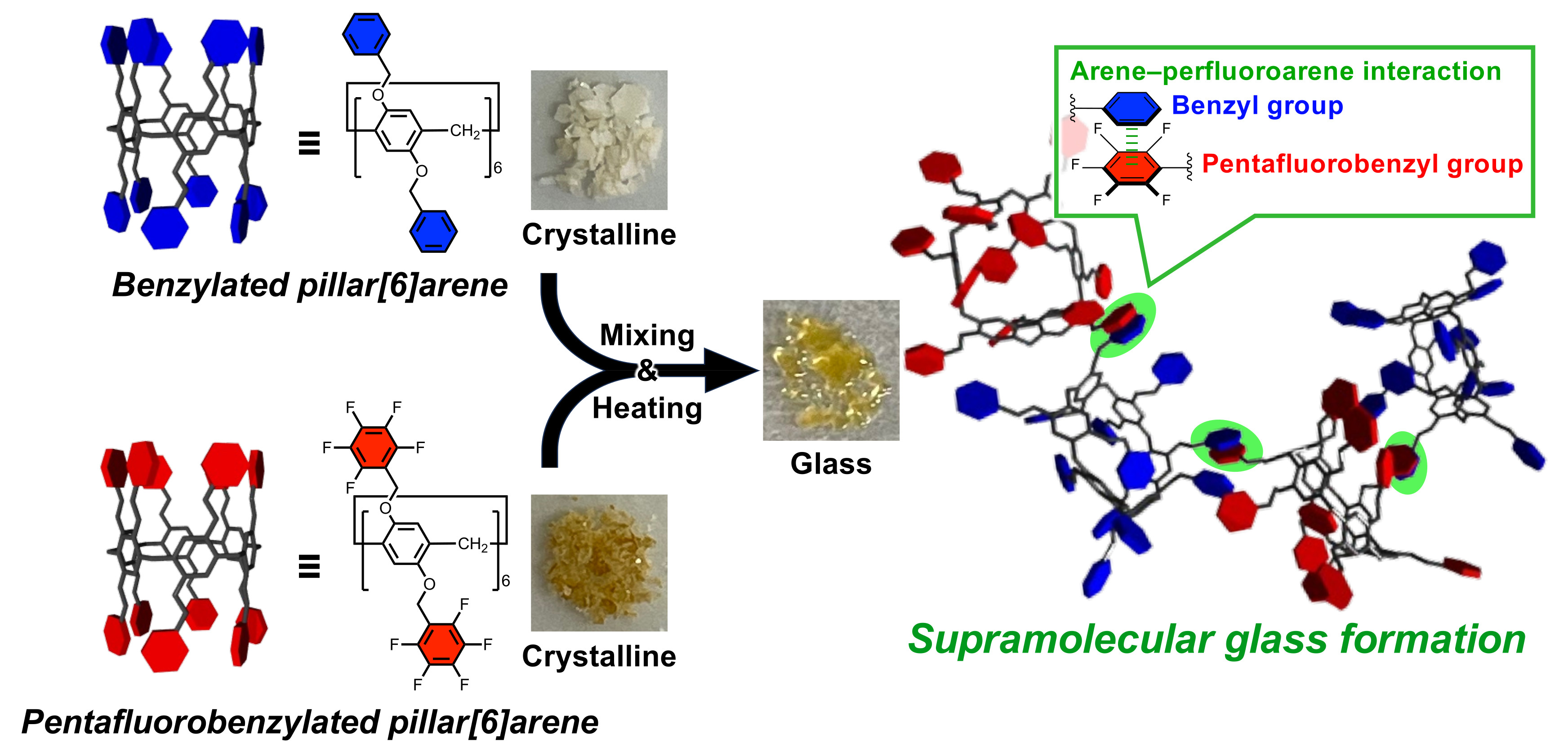
Molecular glass formation was achieved by mixing and heating pillar[6]arenes bearing benzyl and pentafluorobenzyl groups. This result shows that interactions involving fluorinated aromatic rings can be used to control glass formation in three-dimensional macrocycles.Chem. Commun. 2026
![Fluorinated Conjugated Microporous Polymers Based on Pillar[n]arenes for Removal of Water Pollutants and Their Cation Selective Adsorption](images/publication/2024/2024-17.jpg)
Polymer materials effective for separation were constructed by linking macrocyclic frameworks with heteroatom-containing linkers.ACS Appl. Mater. Interfaces 2024