Long-Lived Phosphorescent Polymer Materials
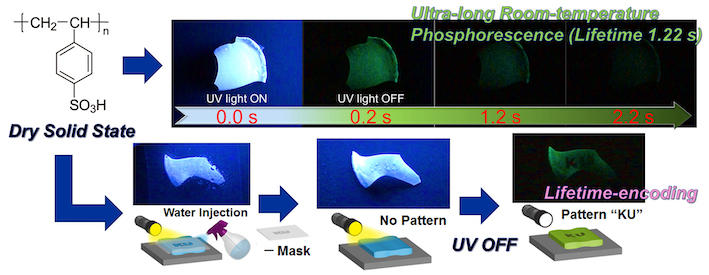
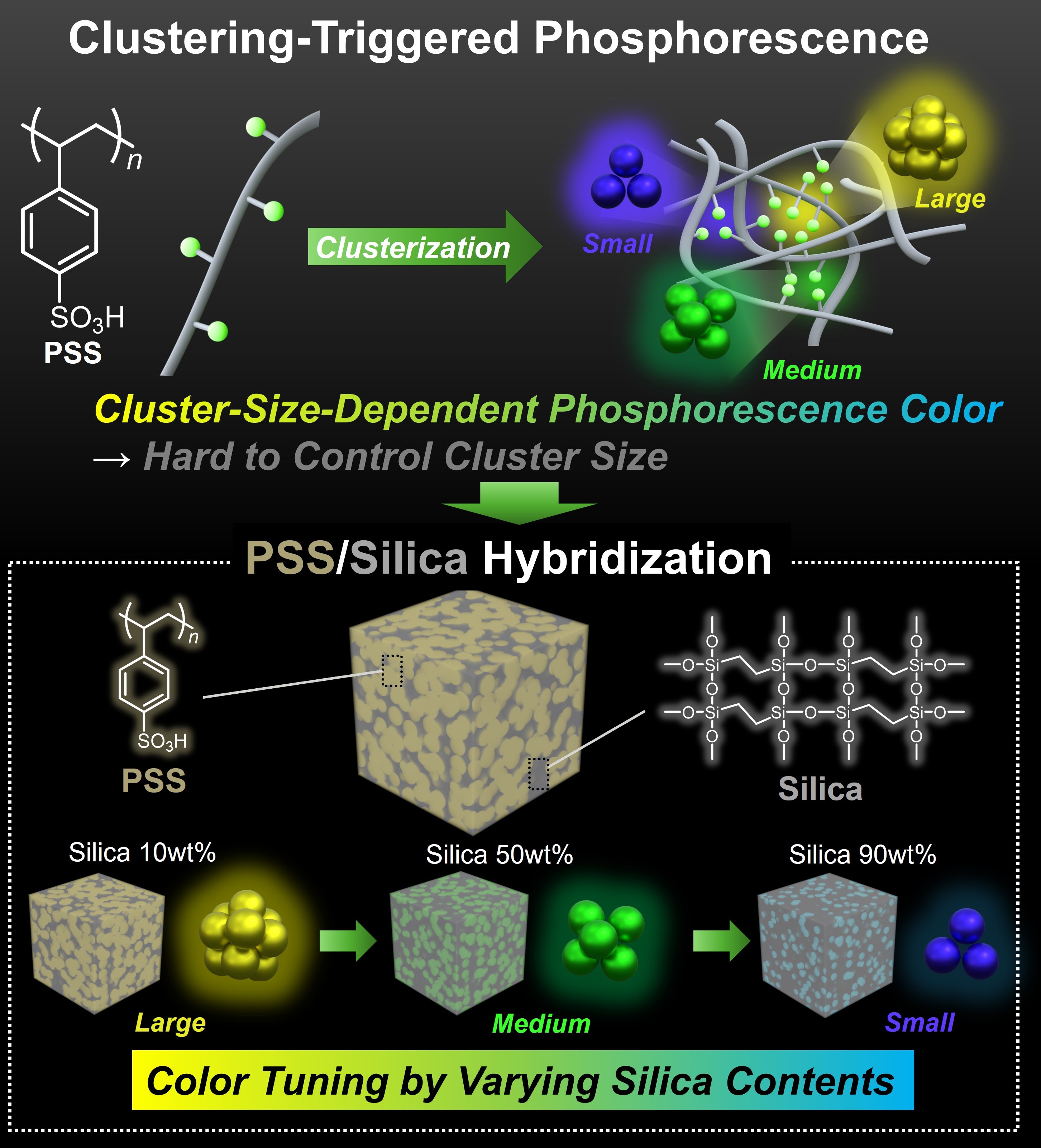
Phosphorescent materials store photoexcitation energy and continue to emit light even after the excitation source is removed. They are used in a wide range of applications, such as luminous watch dials. However, many conventional phosphorescent materials contain rare metals and are therefore costly. We found that the inexpensive, commercially available polymer polystyrene sulfonic acid (PSS) exhibits ultralong room-temperature phosphorescence lasting longer than 1 s in air after drying (Adv. Funct. Mater. 2018). Because PSS is readily available on a large scale and can form films, it is an attractive platform for practical metal-free phosphorescent polymer materials. We are developing new phosphorescent materials with tunable flexibility and rigidity by using organic–inorganic hybridization and polymer design. Recently, by confining PSS within nanospace in a silica network, we limited the aggregation size of PSS and achieved color tuning from yellow to blue (Angew. Chem. Int. Ed. 2026). This nanoconfinement also improved the photoluminescence quantum yield and phosphorescence lifetime.